
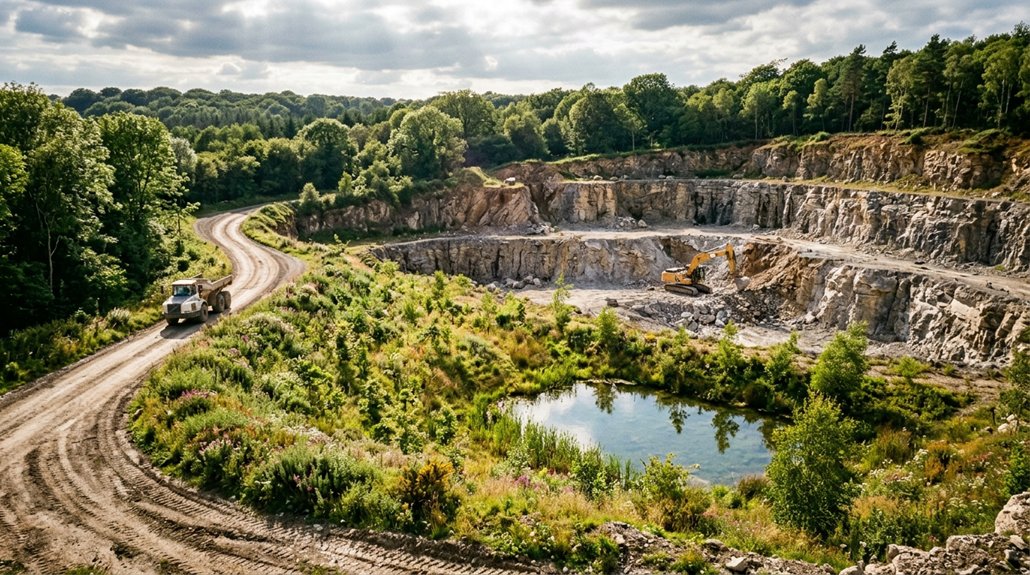
Quarries supply the stone and minerals behind roads, buildings, and infrastructure, yet extraction can alter habitats, water flows, and air quality. When you plan sites around sensitive areas, use materials efficiently, and restore land as work progresses, you can reduce these impacts without abandoning production. The challenge is turning those measures into consistent, measurable practice—and the first decisions often shape every outcome that follows.
What Makes Quarrying More Sustainable?
What makes quarrying more sustainable is reducing environmental harm at every stage, from site planning and extraction to transport and rehabilitation. You can measure progress through indicators such as energy use per tonne, water consumption, dust levels, and the amount of material recovered.
Efficient blasting and precise cutting reduce waste, while closed-loop water systems limit withdrawals and sediment discharge. Innovative technologies, including electric equipment, real-time emissions monitoring, and automated processing, can lower fuel use and improve operational control.
You can also reduce transport impacts by optimizing haul routes, maintaining vehicles, and processing materials closer to where they’re used when practical. Sustainable practices include reusing overburden, controlling noise and dust, and progressively restoring disturbed land.
Regular audits help you verify results, identify weak points, and update targets as equipment, methods, and environmental requirements change.
Plan Quarry Sites Around Sensitive Habitats
Before selecting a quarry site, map sensitive habitats, wildlife corridors, wetlands, and protected species ranges using current ecological surveys and regional conservation data.
Use these findings to compare candidate sites and avoid areas with high ecological value or irreplaceable features.
Assess how excavation boundaries, access roads, and noise or lighting could affect nearby ecosystems.
Habitat fragmentation can isolate populations and restrict species migration, so maintain connected corridors between feeding, breeding, and refuge areas.
Consult local ecologists and Indigenous communities to identify seasonal patterns and less visible habitat use.
Where impacts remain likely, revise site boundaries or choose another location rather than relying solely on later restoration.
Establish baseline indicators, such as species presence and water conditions, then monitor them throughout operations.
Clear thresholds should trigger prompt mitigation when ecological conditions decline.
Use Stone and Minerals More Efficiently
Efficient material use starts with designing quarry plans around the usable yield of each deposit. You can map grade and fracture patterns before extraction, then match cutting methods to stone dimensions and product specifications. This improves Efficient resource utilization and reduces off-spec material.
| Practice | Resource benefit |
|---|---|
| Model deposit quality | Target usable zones |
| Optimize cutting sequences | Limit breakage and offcuts |
You can also sort recovered fragments by size and composition for aggregates, landscaping, or other suitable products. Track recovery rates and reject volumes by bench; these measurements show where equipment settings or extraction sequences waste material. Mineral conservation depends on extending each deposit’s useful output, not simply increasing tonnage. Set recovery targets, review them regularly, and adjust operations when results fall short. By treating by-products as potential inputs, you can reduce demand for newly quarried material and lessen the land disturbance associated with replacement extraction.
Reduce Water Use and Protect Local Supplies
You can reduce freshwater demand by capturing and recycling process water, while treating runoff to prevent sediment and contaminants from reaching local waterways.
Monitor nearby wells and surface waters against baseline conditions so you can detect changes early.
These controls help protect community supplies and quarry ecosystems.
Recycle Process Water
Quarries can recycle water from washing, cutting, and dust suppression to reduce freshwater withdrawals and limit pressure on local supplies. You can capture process flows in sumps, then route them through settling tanks, screens, or clarifiers to remove suspended solids.
Reuse the recovered water in suitable operations, matching its quality to each task and monitoring flow, turbidity, and pH. A closed-loop system can lower demand for groundwater and municipal supplies, especially during dry periods.
Size storage and treatment capacity for production peaks, and maintain pumps and filters to keep circulation reliable. Water recycling also supports efficient irrigation when reclaimed water meets applicable requirements and doesn’t compete with operational needs.
Track withdrawal and reuse volumes so you can verify savings, identify losses, and adjust the system as quarry conditions change.
Prevent Water Contamination
Prevent water contamination by keeping clean stormwater separate from runoff exposed to fuel, lubricants, sediment, and processing chemicals. You can use berms, lined channels, and covered stockpiles to divert clean water and limit contact with pollutants.
Grade work areas to direct contaminated runoff into contained sumps, not toward streams or recharge zones. Inspect equipment for leaks, store chemicals in secondary containment, and refuel on impermeable surfaces away from drainage paths.
Apply Water filtration and settling systems to captured process water before reuse or authorized discharge; select treatment for the specific pollutants present.
Minimize water use by repairing leaks, using spray controls, and reusing suitable water. These contamination prevention measures reduce pollutant loads and protect aquatic habitat while supporting efficient quarry operations.
Train crews to follow spill-response procedures and maintain containment structures.
Monitor Local Supplies
How much water can a quarry withdraw without stressing local supplies? You can answer only by measuring withdrawals against seasonal recharge, streamflow, groundwater levels, and community demand. Establish baseline conditions before extraction, then track wells, surface water, rainfall, and discharge at regular intervals.
Set site-specific thresholds with hydrologists and local water users; reduce pumping when levels approach them.
Improve resource management by recycling process water, capturing rainfall, repairing leaks, and using dry or low-water dust controls where practical. Record consumption by activity, and compare actual use with permits and forecasts.
If monitoring shows declining levels, reduced streamflow, or competing needs, you should cut withdrawals, adjust operations, or pause pumping. Share results with regulators and residents.
Protecting the Local supply requires transparent data and adaptive limits, not assumptions about abundance.
Control Quarry Dust, Noise, and Emissions
Although quarrying inevitably generates dust, noise, and exhaust, well-designed controls can limit their effects on workers, nearby communities, and ecosystems. You can reduce airborne particles by applying Dust suppression at haul roads, crushers, and transfer points. Use water sprays or suitable binding agents, and maintain equipment to prevent leaks and unnecessary dust generation. Enclose conveyors and stockpiles where practical, and monitor particulate levels to check whether controls work.
For noise mitigation, you can install acoustic barriers, maintain mufflers, and schedule the loudest tasks during permitted hours. Measure sound at site boundaries and provide workers with properly fitted hearing protection.
To cut emissions, choose efficient machinery, avoid prolonged idling, and service engines regularly. Track fuel use and exhaust performance, then adjust operations when monitoring identifies problems. These measures protect human health while reducing the quarry’s environmental footprint.
Protect Wildlife During Quarry Operations
Dust, noise, and emissions controls reduce some pressures on wildlife, but quarry operations can also disturb habitat, disrupt breeding, and cause animal deaths. You can limit these risks through seasonal surveys, exclusion zones, and clear operating protocols.
| Quarry risk | Protective response |
|---|---|
| Nest disturbance | Schedule work outside breeding periods |
| Vehicle collisions | Set low speeds and wildlife crossings |
| Fragmented habitat | Maintain Wildlife corridors |
| Den destruction | Mark and buffer occupied sites |
Use camera traps and field surveys to track species activity; adapt work when monitoring shows changes. Protect water sources and retain native vegetation through habitat preservation. Train crews to recognize tracks, nests, and distress calls, and require prompt reporting. These measures help you avoid preventable harm while keeping extraction accountable. Coordinate with wildlife specialists and regulators to set site-specific thresholds and verify compliance. Don’t treat quiet sightings as proof that animals are absent.
Restore Land as Quarrying Progresses
As extraction advances, restore worked areas in phases rather than waiting until quarrying ends. You’ll limit erosion and shorten the time disturbed land remains exposed. Use progressive rehabilitation plans that link each completed bench or pit section to measurable closure criteria.
Before reshaping, retain and separately stockpile suitable topsoil; protect it from compaction and erosion, then replace it at an appropriate depth. Regrade slopes to stable contours, install drainage that disperses runoff, and establish native plants suited to local soils and climate.
Monitor vegetation cover, soil stability, and water quality, then adjust treatments when results fall short.
Effective Land regeneration depends on using locally appropriate materials and tracking outcomes, not simply planting trees. Integrate ecosystem restoration goals into operational schedules, budgets, and inspections.
This approach can rebuild habitat functions while quarrying continues, reducing long-term liabilities and improving site resilience.
Work With Nearby Communities
Build trust with nearby communities by sharing clear, timely information about quarry plans, impacts, and monitoring results. You’ll strengthen Community engagement when residents can question decisions, report concerns, and help shape practical responses. Use regular meetings and accessible notices, not one-way announcements.
| Priority | Your action | Community benefit |
|---|---|---|
| Listening | Hold open forums | Concerns inform plans |
| Access | Publish plain-language updates | Residents stay informed |
| Safety | Coordinate traffic routes | Fewer local disruptions |
| Jobs | Hire and train locally | Stronger local economic impact |
Work with schools, businesses, and community groups to identify needs and establish clear contact channels. Track commitments, assign staff, and report progress so people can see whether you’ve acted on their input. When disputes arise, respond promptly, explain trade-offs, and document agreed steps. Respect local knowledge; it can reveal sensitive places and practical solutions that technical plans may miss.
Measure Quarrying’s Environmental Performance
Community feedback is most useful when you can compare it with measured results. Track your quarry’s Environmental impact using a baseline established before extraction begins. Monitor dust concentrations at site boundaries, noise levels near homes, surface-water quality, groundwater levels, and habitat condition. Use calibrated instruments, consistent sampling schedules, and documented methods so you can detect changes and verify compliance.
Choose Performance metrics that connect operations to outcomes, such as particulate matter per tonne produced, water reused as a share of total demand, and hectares restored against your approved plan. Record results transparently, including exceedances and corrective actions. Compare trends with permit limits and baseline conditions, not isolated readings.
When measurements reveal deterioration, adjust blasting, haulage, drainage, or rehabilitation practices promptly. Share results with nearby residents and regulators; their scrutiny can strengthen accountability and guide practical improvements.
Frequently Asked Questions
What Permits Are Required to Open a Quarry?
You’ll typically need a land-use or zoning approval, a quarry or mining permit, and environmental clearances before opening. Requirements vary by jurisdiction, so confirm them with your local planning and mining authorities.
You may also need water-use, stormwater, air-emissions, blasting, and access permits.
Prepare an Environmental impact assessment where required, and document community engagement.
Authorities may require reclamation plans, financial assurance, operating conditions, inspections, and public notice before granting approval.
How Long Does Quarry Development Typically Take?
You’ll typically need three to seven years to develop a quarry, though permitting, geology, and infrastructure can shift the timeline substantially.
In the United States, environmental reviews under the National Environmental Policy Act can take years for complex projects, making early planning essential. You’ll reduce delays by evaluating Environmental impact, completing baseline studies, and starting community engagement before submitting applications.
Your schedule should include land acquisition, permits, design, construction, and commissioning, with contingency time for appeals.
Which Materials Are Commonly Extracted From Quarries?
Quarries commonly supply crushed stone, sand, gravel, limestone, granite, marble, slate, clay, and gypsum. You’ll find these materials in construction, road building, cement production, and landscaping.
The specific resource depends on local geology and market demand.
Extraction can cause habitat loss, dust, noise, and altered drainage, so assess Environmental impact before development.
You can reduce harm through Sustainable practices, including progressive rehabilitation, water management, dust control, and efficient material use.
What Careers Are Available in the Quarrying Industry?
You can build a career in quarrying as a geologist, mining engineer, surveyor, equipment operator, maintenance technician, safety officer, or environmental specialist—the industry’s gears turn through many skilled roles.
Career opportunities also include laboratory testing, logistics, and site management.
You might focus on Sustainable practices by monitoring dust, water, noise, and habitat impacts, then applying evidence-based controls.
Training in geology, engineering, trades, or environmental science can prepare you for these positions.
How Are Quarry Products Transported to Customers?
You receive quarry products by truck, rail, barge, or ship, depending on distance, volume, available infrastructure, and material type.
Transportation logistics teams coordinate loading, route planning, scheduling, and delivery to reduce delays and fuel use.
Common delivery methods include bulk tipping, conveyor transfer, and container shipment.
You can lower transport emissions by choosing nearby suppliers, consolidating loads, and using rail or water freight where practical.
Tracking systems help you monitor deliveries and verify quantities.
Leave a Reply