
The most powerful mining and quarry machinery helps you move more material, process rock faster, and keep demanding sites productive. High-capacity excavators, haul trucks, loaders, crushers, drilling rigs, and earthmoving equipment combine robust structures with advanced systems to handle heavy workloads and harsh conditions. Choosing the right machines can reduce downtime and improve output, but raw capacity isn’t the only factor that determines performance—you’ll need to contemplate how each machine fits your operation.
The Most Powerful Mining and Quarry Excavators
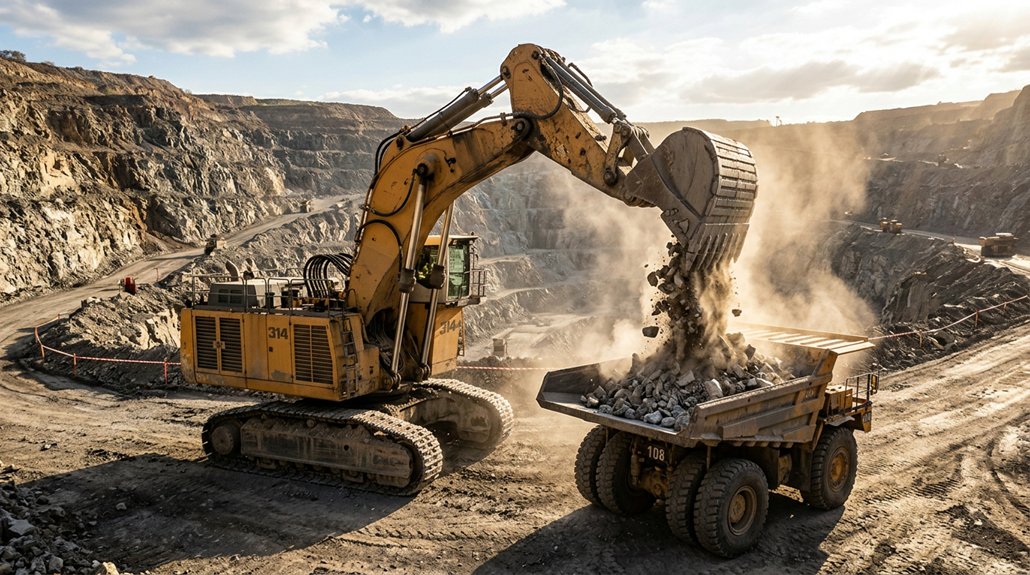
Mining and quarry excavators deliver the breakout force, reach, and durability needed to move massive volumes of material in demanding conditions. When you select a machine, match its operating weight, bucket capacity, and digging geometry to your site’s geology and production targets.
Advanced hydraulic systems deliver responsive control and efficient power, helping you cut cycle times while managing fuel use. Reinforced booms, heavy-duty undercarriages, and protected components withstand abrasive rock and continuous loading, reducing downtime and repair costs.
An ergonomic cabin design gives you clear sightlines, intuitive controls, and reduced vibration, supporting safe, precise operation across long shifts.
Choose attachments that suit your material and task, then maintain filters, joints, and wear parts on schedule. The right excavator turns demanding excavation into consistent, measurable production without compromising operator comfort or machine life.
High-Capacity Haul Trucks for Moving More Material
High-capacity haul trucks let you move more material per cycle, increasing payload capacity without sacrificing control.
Efficient haul routes and fast cycle times help you maximize throughput and lower cost per tonne.
Reliable fleets keep your operation moving and reduce unplanned downtime.
Payload Capacity
How much material can your operation move in each haul cycle? Payload capacity determines how effectively your trucks convert rated capability into delivered tonnage. Match each truck’s capacity to your excavators, loading tools, and site conditions so you can fill the body without exceeding manufacturer limits.
Consistent payloads protect structural components, tires, and suspension from avoidable stress while supporting predictable production targets.
Use onboard weighing systems to monitor each load and identify underloading or overloads. Payload optimization depends on accurate readings, disciplined loading practices, and clear operator guidance.
Pay close attention to weight distribution: an uneven load can compromise stability and concentrate stress on specific components. Configure the body and loading sequence to spread material evenly across the truck.
When you manage capacity precisely, you gain more usable tonnage per cycle and extend equipment life without sacrificing safety or reliability.
Haul Efficiency
Haul efficiency depends on how much material each truck moves per cycle and how quickly it completes the haul. Choose high-capacity trucks that match your loading equipment and route conditions. This balance reduces trips and keeps material flowing to the crusher or stockpile.
| Efficiency factor | Operational result |
|---|---|
| Payload match | Fewer, productive cycles |
| Road design | Shorter travel times |
| Dispatch planning | Less queuing |
| Automation technology | More consistent routing |
You can improve output by minimizing loaded travel distance, managing speed on grades, and coordinating loading and dumping schedules. Use real-time haul data to identify bottlenecks and adjust assignments before delays reduce throughput. Efficient cycles also lower fuel use per tonne, helping limit environmental impact. Compare truck capacity with road width, turning radius, and ground conditions to maintain practical speeds without sacrificing safe control. Measure tonnes moved per hour, not capacity alone, to verify results.
Fleet Reliability
Reliable high-capacity haul trucks move more material per cycle, but only when they’re matched to loading equipment, routes, and operating conditions. You’ll protect that productivity by selecting payload capacity that suits your excavators and haul distances without overloading frames, tires, or drivetrains.
Assess gradients, road surfaces, turning radii, and cycle times before assigning trucks to routes; poor matches increase fuel use and component wear.
Use condition monitoring to detect heat, vibration, and pressure changes before they trigger failures. Follow maintenance schedules based on operating hours and equipment data, not guesswork, and stock critical parts where crews can access them quickly.
Operator training helps your drivers manage braking, shifting, payload distribution, and safe speeds across changing terrain. With disciplined dispatch, inspections, and repair planning, you’ll sustain availability, reduce unplanned downtime, and move more material reliably.
Mining Loaders Built for Fast, Heavy-Duty Work
When production targets leave little room for delay, mining loaders move ore and waste quickly through demanding underground and surface operations. You can match machine capacity to haul distances, tunnel dimensions, and material density to maintain steady cycles.
High breakout force, responsive hydraulics, and durable buckets help your operators fill efficiently and handle abrasive loads. Choose articulated designs for tight headings or larger wheel loaders for open, high-volume routes.
Automated controls and clear visibility support precise maneuvering, while service access reduces downtime between shifts.
Mining safety improves when you specify effective braking, stability systems, and operator protection suited to site conditions. Select electric or low-emission power where practical to reduce fuel use and environmental impact.
With the right loader configuration, you’ll move more material per hour, control operating costs, and keep production flowing without compromising equipment life.
Crushers and Screens That Process More Rock
Crushers and screens turn mined rock into consistent, specification-ready material for downstream processing. You can match jaw, cone, or impact crushers to feed size, hardness, and target product, then use screening decks to separate material accurately. Correct sizing reduces recirculation, limits unnecessary wear, and keeps your plant moving more tonnes per hour.
With automation integration, you can monitor load, adjust settings, and coordinate conveyors and screens to maintain steady throughput. Sensors can flag blockages or abnormal vibration before they cause costly stoppages.
Choose modular equipment and accessible wear parts to simplify maintenance and shorten changeovers.
Sustainable practices also improve performance: efficient drives reduce energy use, while water management and dust suppression help control site impacts. When you balance capacity, product quality, and uptime, your crushing circuit delivers dependable output across changing rock conditions.
Drilling Rigs That Reach Deeper and Work Faster
Drilling rigs extend mine development into deeper, harder-to-reach zones while advancing more metres per shift. With the right rig, you can maintain penetration rates through abrasive formations, control hole deviation, and reach planned depths with fewer interruptions.
High-pressure rotary and down-the-hole systems deliver the torque and impact energy your geology demands, while durable drill strings withstand sustained loads.
Innovative drilling technologies combine real-time sensing with precise feed control, helping you adjust parameters as rock conditions change. Automated drilling systems manage repetitive cycles, reduce operator exposure, and improve consistency across shifts.
You’ll also gain actionable data on penetration, bit wear, and equipment performance, allowing crews to schedule maintenance before failures disrupt production. Match rig capacity, mast reach, and power to your mine plan, and you can improve metres drilled per day while protecting borehole quality and lowering cost per metre.
Bulldozers and Graders for Tough Site Conditions
When you face heavy clearing, bulldozers move overburden and debris efficiently.
Graders create precise, stable surfaces for haul roads and work areas.
In harsh conditions, you need machines built to maintain traction, control, and uptime.
Bulldozers for Heavy Clearing
On demanding mine sites, bulldozers clear dense vegetation, push overburden, and shape rough ground with the traction and blade force heavy work requires. You can match machine weight, track configuration, and blade type to soil conditions and material volume, maintaining momentum without excessive ground disturbance.
Rippers break compacted layers and embedded rock before the blade moves spoil, reducing strain on the powertrain. For reliable production, inspect undercarriage wear, hydraulic lines, cutting edges, and cooling systems before each shift.
Your operators should use controlled passes, maintain clear sightlines, and follow exclusion zones to strengthen construction safety around workers and equipment. Plan clearing limits and protect drainage channels to reduce environmental impact.
With disciplined maintenance and route planning, you’ll clear access corridors and prepare work areas efficiently, even across steep, uneven terrain.
Graders for Precise Surfaces
Graders create precise mine roads and working surfaces by cutting high spots, filling low areas, and setting consistent cross-slopes. With precision shifting, you control drainage, improve haul-truck stability, and reduce rolling resistance. Set the moldboard angle and blade depth to match material, grade targets, and road geometry. Use survey data or machine guidance to hold elevations and cross-falls accurately. Check finished lanes against design tolerances; consistent surface smoothness supports safer, more predictable hauling.
| Grading target | Operational result |
|---|---|
| Crown and cross-slope | Directs runoff |
| Smooth progressions | Limits jolts |
| Accurate elevation | Meets design |
| Even material spread | Reduces rework |
You’ll get the best results when operators make measured passes, avoid overcutting, and verify the finished profile. Coordinate grading with haul-road plans so each route delivers reliable access and efficient material movement.
Performance in Harsh Conditions
Harsh mine conditions demand bulldozers and graders that maintain traction, control, and uptime across mud, loose rock, steep grades, and extreme temperatures. Choose machines with reinforced undercarriages, high-capacity cooling systems, sealed electrical components, and terrain-matched tracks or tires. These features help you sustain production while reducing wear and unplanned downtime.
Use blade controls and grader articulation to manage material precisely on uneven haul roads and working benches. Match machine weight, power, and ground pressure to site conditions; then adjust operating techniques as surfaces change.
Regular inspections, scheduled servicing, and operator training protect performance and extend component life.
Apply safety protocols for slope work, visibility, and machine separation. Monitor changing ground conditions, maintain clear communication, and stop work when stability is uncertain.
Consider environmental impact when planning routes and controlling dust, runoff, and soil disturbance. This approach helps you deliver reliable results in demanding operations.
How to Match Mining Machinery to Your Operation
To match mining machinery to your operation, start with the material you move, the conditions you work in, and the production rate you need to achieve. Assess rock hardness, abrasiveness, moisture, and fragmentation to select equipment with the right power, bucket capacity, and wear protection.
Then compare haul distances, gradients, road quality, and turning space against machine dimensions and payload. Your fleet should meet target throughput without creating bottlenecks at loading, hauling, or crushing stages.
Factor in availability, fuel use, maintenance access, and parts support to control lifecycle costs. Check that operators can use the equipment safely and efficiently, and align each machine with your safety protocols.
Consider the environmental impact of emissions, noise, dust, and ground disturbance; choose suitable controls and power options. Validate your selection against site data, then track productivity and adjust fleet size as conditions change.
Frequently Asked Questions
What Safety Features Should Mining and Quarry Machinery Include?
Your mining and quarry machinery should include rollover protection, enclosed operator cabins, seat belts, emergency-stop controls, backup alarms, cameras, guards, fire suppression, and reliable brakes.
Use sensors to detect proximity, equipment faults, and hazardous gases, then provide clear visual and audible alerts.
Establish Safety protocols for inspections, lockout/tagout, and operator training.
Define Emergency procedures for fires, entrapment, and equipment failure, and guarantee workers can access communication systems, first-aid supplies, and safe evacuation routes.
How Can Operators Reduce Fuel Consumption Across a Heavy-Equipment Fleet?
You can cut fleet fuel use by matching machine size to each task, minimizing idle time, and maintaining engines, tires, and hydraulics.
As the saying goes, “you can’t manage what you don’t measure”: track consumption by machine and operator, then address outliers with coaching and service.
Improve Fuel efficiency through steady speeds and planned routes.
Use Equipment optimization tools to schedule loads, coordinate dispatch, and monitor performance, turning operational data into measurable savings without sacrificing productivity or safety.
What Maintenance Schedule Helps Prevent Costly Equipment Downtime?
Set a risk-based maintenance schedule: check fluid levels, tires, tracks, brakes, and safety devices before each shift. Inspect filters, belts, and leaks weekly. Service components at manufacturer-recommended operating-hour intervals.
Use Preventive inspections to spot wear early, and test Hydraulic systems for leaks, pressure loss, and contamination.
Track findings in your maintenance system, prioritize critical defects, and keep essential parts available. You’ll reduce unplanned downtime without replacing serviceable components too soon.
Should Mining Machinery Be Purchased, Leased, or Rented?
Choose the option that matches your utilization, cash flow, and project duration.
Buy machinery when you’ll use it consistently for years and can manage maintenance and resale risk.
Consider Equipment financing to preserve working capital while building ownership.
Leasing benefits include predictable payments, newer technology, and easier fleet upgrades; lease when needs remain steady but capital is limited.
Rent for short projects, seasonal peaks, or uncertain demand.
Compare total operating costs, availability, and contract terms before committing.
How Do Emissions Regulations Affect Mining Equipment Choices?
Emissions regulations steer your equipment choices like a compass through a tightening tunnel: they determine which engines can operate, where you can deploy them, and what upgrades you’ll need. Check local Emission standards before buying, leasing, or renting; stricter limits may favor newer diesel engines, electric machines, or retrofit-ready models.
Prioritize Regulatory compliance to avoid fines, downtime, and costly replacements. Compare fuel use, service access, and expected operating hours to protect productivity and control total ownership costs.
Leave a Reply