
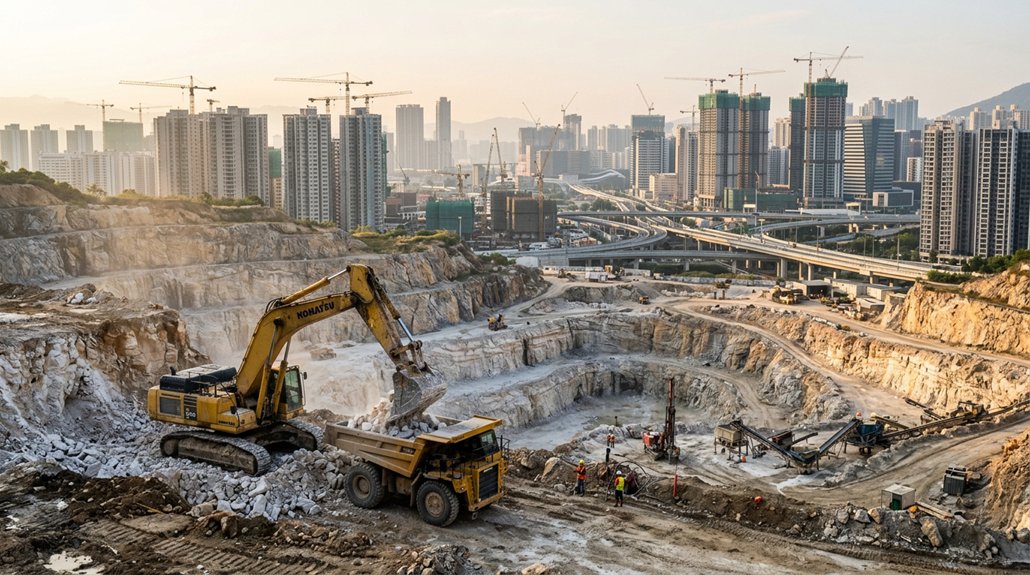
You see quarrying’s role in a city every day, from the aggregate beneath its roads to the stone in its buildings. Nearby quarries supply the materials that keep construction moving, support local jobs, and reduce transport distances. But extraction also changes land, water, and habitats, so urban growth depends on more than a steady supply. The choices made around quarry sites can shape a city long after the last load leaves.
How Quarrying Supplies the Materials Cities Need
As cities expand, quarries supply the stone, sand, and gravel needed to build roads, foundations, and concrete structures. You rely on this steady supply to keep construction schedules aligned with demand and to reduce dependence on distant sources.
Quarry operators assess deposits, extract suitable rock, and process it to meet engineering specifications. They also coordinate transport and production so materials reach projects when needed.
Local sourcing can shorten delivery routes, limit supply disruptions, and support predictable costs.
Before extraction begins, planning must account for land use, water, noise, and nearby communities. You should also consider Historical preservation and Cultural significance when quarry sites or surrounding landscapes hold heritage value.
Responsible operations balance urban growth with environmental safeguards, regulatory compliance, and long-term community interests, helping cities secure essential resources without overlooking local priorities or future needs.
Which Quarry Materials Build Urban Infrastructure?
You rely on concrete aggregates—crushed stone, sand, and gravel—to form durable foundations, slabs, and structural elements.
For streets and highways, road-building stone provides graded layers that support traffic and stabilize pavement. The material’s size, strength, and durability determine how well each layer performs.
Concrete Aggregates
Concrete aggregates—crushed stone, sand, and gravel—form the mineral skeleton of the concrete used in foundations, bridges, roads, and other urban infrastructure. Their grading, shape, and cleanliness influence strength, workability, and durability, so you need aggregates that meet project specifications.
Quarry operators crush and screen rock into controlled sizes, while washing removes clay and other contaminants. Sand and gravel deposits provide naturally rounded particles; crushed stone offers angular surfaces that can improve bonding with cement paste.
Your mix design balances these materials to limit voids and achieve required performance. Sustainable sourcing helps protect local resources and reduce transport emissions. Innovative recycling can also supply processed concrete aggregate for suitable applications, conserving virgin material.
Road-Building Stone
Road-building stone forms the load-bearing layers beneath urban streets, from compacted subbase to the asphalt or concrete surface. You rely on crushed, well-graded aggregates—typically limestone, granite, or basalt—to distribute traffic loads and limit settlement.
Coarser stone creates stable subbase and base courses; finer, angular aggregate improves asphalt interlock and surface durability. For concrete pavements, durable crushed stone supports a rigid slab and controls deformation.
Your project’s specifications should set particle size, shape, strength, abrasion resistance, and cleanliness. Quarry operators process and test material to meet those requirements, while consistent grading helps crews compact each layer effectively.
Responsible sourcing also matters: quarrying safety protects workers and nearby communities, and environmental regulations govern dust, noise, water, and habitat impacts. Choose compliant suppliers to build resilient streets and reduce maintenance demands.
Where Quarry Products Shape Everyday City Life
Where do quarry products enter daily urban life? You encounter them in the concrete sidewalks, masonry walls, and stone steps that connect homes, shops, and public services. Crushed aggregate also forms the base beneath pavements and helps stabilize building foundations, while limestone and granite appear in countertops, façades, and civic structures. These materials shape spaces you use, not just the city’s visible skyline.
In urban green spaces, quarried stone defines paths, retaining walls, seating, and drainage features, supporting safe access and durable landscapes. Carefully selected stone also contributes to cultural heritage preservation: you see it in repaired historic façades, monuments, and public squares, where compatible materials protect original character.
Quarry products thus influence your daily routes, shared amenities, and sense of place through their performance, finish, and fit with the urban environment.
How Local Quarries Support Urban Growth
When you build a city, local quarries supply aggregates and stone for roads, foundations, and concrete.
Shorter transport distances can reduce delivery costs and material-related emissions.
Quarry operations also support local economies through jobs, contracts, and tax revenue.
Supplying Building Materials
As cities expand, local quarries supply the crushed stone, sand, and gravel needed for concrete, roads, and foundations. When you build nearby, these materials travel shorter distances, helping you maintain reliable construction schedules and reduce transport demand.
Quarries process rock to specified sizes and grades, so you can select aggregates suited to structural concrete, drainage layers, pavement bases, and utility trenches. Consistent testing verifies particle distribution, strength, and cleanliness, supporting predictable performance in finished infrastructure.
Operators coordinate extraction and processing with project requirements, while you can plan deliveries around construction phases.
Responsible production also depends on quarrying safety and compliance with environmental regulations. Dust controls, water management, equipment safeguards, and monitored extraction help limit hazards and impacts.
This dependable material supply enables you to build essential urban infrastructure at scale.
Supporting Local Economies
Reliable material supply also keeps more economic activity close to urban projects. When you source aggregate from nearby quarries, you reduce transport costs and delays while directing spending toward local operators, workers, and service providers.
Quarry employment supports household income, and procurement creates demand for equipment maintenance, fuel, logistics, and engineering. These linked activities strengthen economic diversification, helping communities rely on more than a single sector.
Local tax and royalty revenues can also fund roads, utilities, and public services that enable urban expansion. Through responsible planning, you can align extraction with infrastructure schedules, limit disruption, and support community development.
Quarries must manage environmental impacts and coordinate with residents and authorities. This approach helps you build dependable supply chains while ensuring urban growth generates durable local benefits, not just construction output.
What Quarrying Changes in the Local Environment
Quarrying reshapes the local environment by removing vegetation and soil, altering landforms, and exposing underlying rock. You’ll see excavation create benches, pits, and spoil piles that change drainage patterns and surface stability.
Blasting and heavy equipment generate noise, vibration, and dust, while runoff can carry sediment into nearby streams. These changes may affect water quality, soil structure, and habitat connectivity beyond the extraction area.
The biodiversity impact depends on the site’s original ecosystems, the scale of disturbance, and the species present. You may also observe altered groundwater flow where excavation intersects aquifers or fractures.
Environmental restoration can rebuild landforms and vegetation after extraction, but it can’t immediately recreate mature soils or complex habitats. Quarrying thus leaves physical and ecological changes whose extent varies with geology, hydrology, and operating practices.
How Communities Can Reduce Quarrying’s Impacts
Communities can reduce quarrying’s impacts by shaping decisions before extraction begins and monitoring operations throughout their life cycle. Through community engagement, you can identify sensitive receptors, such as homes, waterways, and wildlife corridors, and press operators to assess site-specific risks.
Request clear baseline data on air quality, noise, groundwater, traffic, and habitat conditions. Use that evidence to inform permit conditions, operating hours, haul routes, and enforceable monitoring thresholds.
During extraction, you can review published monitoring results, report exceedances, and seek prompt corrective action from regulators and operators. Effective environmental mitigation may include dust suppression, noise barriers, runoff controls, habitat buffers, and progressive rehabilitation.
Ask for named contacts, response deadlines, and public reporting schedules so concerns receive documented follow-up. As closure approaches, participate in reclamation reviews and verify that agreed landforms, drainage, and vegetation targets are met.
Why Responsible Quarrying Matters to Cities
When managed responsibly, quarrying can support a city’s growth while limiting harm to nearby residents and ecosystems. You depend on stone and aggregate for roads, buildings, and utilities; responsible operations help secure these materials without shifting excessive costs onto neighborhoods. They also reduce Environmental impact through dust controls, efficient water use, noise limits, and monitored transport routes. Strong community engagement lets you identify local concerns early and verify that operators meet measurable standards.
| City priority | Responsible quarrying measure |
|---|---|
| Reliable materials | Planned, regulated extraction |
| Cleaner air | Dust suppression and monitoring |
| Water protection | Runoff controls and testing |
When you require transparent reporting and enforceable permits, you strengthen public trust, protect health, and support predictable construction supply. These safeguards make quarrying a more accountable part of urban development.
What Happens to Quarries After Extraction Ends?
After extraction ends, a quarry enters closure and reclamation, guided by permit conditions and an approved site plan. You’ll see operators stabilize slopes, remove unsafe structures, manage drainage, and monitor groundwater.
They may replace topsoil, replant native vegetation, or reshape land to control erosion and support habitat. Effective Rehabilitation strategies address site-specific risks and comply with regulatory standards; monitoring verifies that measures perform as intended.
Your community can determine Post mining land use through planning that considers geology, water quality, access, and local needs. A quarry might become a reservoir, park, wildlife habitat, or development site, but each option requires engineering review and approvals.
You should expect long-term maintenance where needed, including water treatment or slope inspections. Closure isn’t complete until operators meet agreed reclamation criteria and authorities confirm the site’s safety and intended function.
Frequently Asked Questions
How Is Quarrying Different From Mining?
Quarrying extracts stone, sand, gravel, or other materials from open pits, usually near the surface. Mining broadly removes valuable minerals or fuels, often through underground tunnels or deep open pits.
You’ll find quarrying focuses on bulk construction materials, while mining targets ores, coal, and industrial minerals.
Both alter landscapes, but their Environmental impact depends on location, scale, and restoration.
Technological advancements improve extraction efficiency, worker safety, and environmental monitoring across both industries.
What Regulations Govern Quarry Operations?
Quarry operations are governed by national, regional, and local laws covering permits, land use, worker protection, and environmental compliance. You must secure required approvals before extraction and meet conditions for operating hours, blasting, dust, noise, water discharge, and site rehabilitation.
Environmental impact assessments may identify risks and mitigation measures.
Safety regulations typically require hazard controls, equipment inspections, training, emergency plans, and incident reporting. Check your jurisdiction’s rules, since requirements vary by location and material.
What Skills and Qualifications Do Quarry Workers Need?
You’ll need role-specific training, practical competence, and a strong commitment to safe work. Equipment operators should demonstrate machinery skills; maintenance staff need mechanical or electrical expertise; and supervisors need leadership and hazard-management experience.
Safety protocols require you to recognize risks, use protective equipment, and follow site procedures.
Certification requirements vary by jurisdiction and job, but may include equipment licenses, first aid, and explosives qualifications. Employers may also require physical fitness and ongoing training.
How Are Quarry Sites Selected?
You select a quarry site by confirming that suitable rock exists in sufficient quantity, quality, and depth. Then, you check whether you can extract and transport it safely and economically.
A detailed Site assessment examines geology, access, utilities, nearby communities, land ownership, and regulatory limits.
You also evaluate Environmental impact, including effects on water, habitats, noise, dust, and traffic.
Finally, you compare findings against permitting requirements and rehabilitation plans before deciding whether development is feasible.
How Can Residents Find Information About a Nearby Quarry?
You can find information about a nearby quarry by checking your local government’s planning, environmental, and public health records. The site may be close, but its data shouldn’t be out of reach.
Search permit applications, inspection reports, monitoring results, and public meeting notices. Contact the planning or environmental agency for missing documents, and ask the operator for its community liaison.
Review Community health assessments and Environmental impact reports to understand risks, safeguards, and complaint procedures.
Leave a Reply