
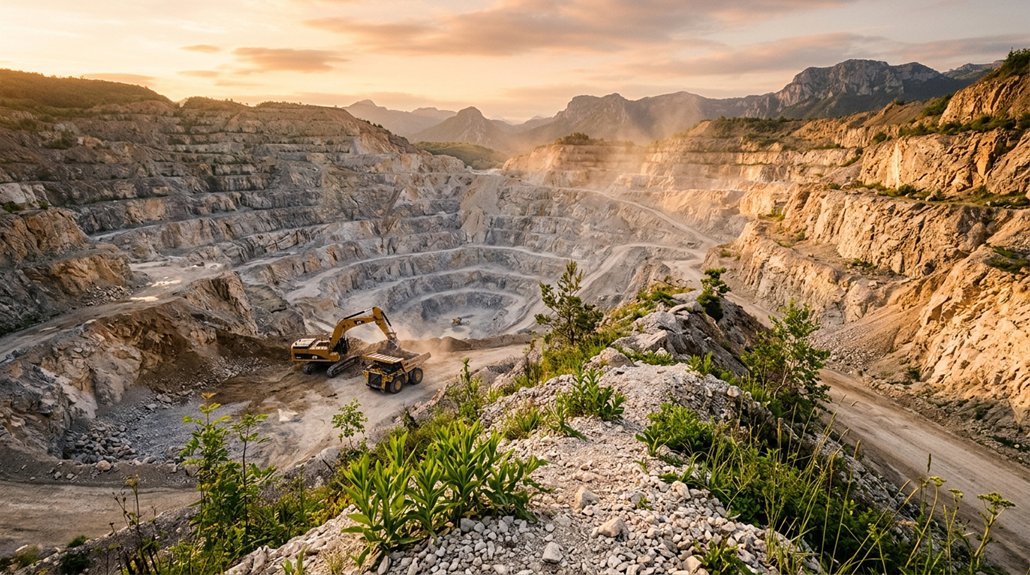
Every kilometre of new road, wind farm, or transmission line depends on quarried materials, though their role often goes unnoticed. You rely on aggregates, stone, and industrial minerals to build the infrastructure that supports daily life and the shift to cleaner energy. But meeting that demand brings difficult questions about safety, emissions, land use, and supply resilience. The answers will shape how responsibly the industry can support your future.
Why Quarry Products Matter in Everyday Life
From the roads you travel to the buildings where you work, quarry products support much of everyday life. Stone, sand, and gravel also appear in less obvious places: glass, ceramics, household surfaces, and materials used to make essential goods.
When you use these products, you rely on minerals selected and processed for specific properties, including strength, durability, and heat resistance.
Their value extends beyond function. Local stone gives buildings distinctive color and texture, connecting familiar streets to regional geology. That link carries historical significance: communities have shaped homes, public spaces, and monuments from nearby resources for generations.
Quarry materials can thus help preserve cultural heritage, especially when restoration requires stone that matches an original structure. Understanding these everyday connections helps you recognize quarry products as both practical resources and lasting records of place.
How Quarries Supply Construction and Infrastructure
When construction begins, quarries supply the graded stone, sand, and gravel that projects need in dependable volumes. You rely on precise mining techniques and quarry equipment to extract, crush, screen, and stockpile materials to specification. That control helps contractors match aggregate properties to structural loads, drainage needs, and pavement designs, while consistent deliveries keep schedules on track. Material selection shapes performance across the built environment:
| Material | Typical use | Performance role |
|---|---|---|
| Crushed stone | Concrete, foundations | Strength and stability |
| Sand | Mortar, concrete | Workability and bonding |
| Gravel | Road bases | Drainage and load distribution |
| Screened aggregate | Asphalt | Gradation and durability |
From local roads to bridges and buildings, quarry operators coordinate quality testing, transport, and production planning. You benefit when nearby sources reduce haul distances, support reliable supply, and provide aggregates that meet engineering standards.
Where Quarry Materials Support Clean Energy
When you build wind farms or solar arrays, you rely on quarried aggregates for stable foundations that withstand heavy loads and harsh conditions. Quarry-derived minerals also support energy storage, serving as inputs for battery components and other storage technologies.
These materials connect quarry operations to the infrastructure that makes renewable power reliable.
Foundations for Renewable Energy
Renewable energy systems depend on more than turbines and solar panels: they need stable foundations built from quarry materials. When you plan a wind farm, graded aggregates create access roads, crane pads, and turbine bases that resist settlement and transfer loads into the ground. Their particle size and compaction determine performance, so you’ll need specifications matched to local soils, drainage, and equipment.
Solar panel materials include crushed stone for firm, permeable mounting surfaces and durable concrete foundations for trackers and support structures.
At geothermal sites, Geothermal support begins with aggregates that stabilize drilling platforms and service routes under heavy machinery. You’ll also rely on quarry stone for erosion control and drainage around energy infrastructure.
Materials for Energy Storage
Energy storage systems rely on quarry materials for stable, durable sites and infrastructure. When you develop battery facilities, crushed stone and aggregate create load-bearing foundations, access roads, drainage layers, and equipment pads. These materials help control settlement and manage stormwater, protecting sensitive systems and keeping maintenance demands predictable.
Quarries also supply limestone, silica, and other minerals used in processing battery materials, though suitability depends on chemistry, purity, and refining capacity. You shouldn’t confuse these industrial inputs with bulk construction aggregate: each requires distinct specifications and quality controls.
As you plan energy storage projects, evaluate local geology, transport distances, material testing, and lifecycle impacts together. Responsible sourcing can reduce hauling emissions and strengthen regional supply chains.
What Challenges Are Reshaping the Quarry Industry?
You must navigate tighter environmental regulations that shape permitting, emissions control, and site rehabilitation.
Labor shortages can constrain production and make skilled-worker retention critical.
Rising fuel, equipment, and compliance costs also pressure margins and accelerate investment in efficiency.
Environmental Regulations
Environmental regulations are reshaping quarry operations by tightening standards for air quality, water use, noise, habitat protection, and site rehabilitation. You must translate each permit into measurable controls, not paperwork alone. Regulatory compliance now demands continuous monitoring, documented corrective actions, and transparent reporting. Emission standards push you to suppress dust, maintain equipment, and track diesel exhaust.
| Pressure | Quarry control | Visible result |
|---|---|---|
| Dust | Sprays, covered conveyors | Clearer haul roads |
| Water | Settling ponds, reuse | Cleaner discharge |
| Noise | Barriers, timed blasts | Quieter boundaries |
| Habitat | Buffer zones, surveys | Protected corridors |
These requirements can raise capital and operating costs, especially when rules differ across jurisdictions. Yet sound planning reduces shutdown risk: map sensitive receptors, audit controls, and budget progressive rehabilitation. Selection of machines designed with environmental impact considerations results in crushing machines and haulage solutions that can be entrusted to meet the toughest of legislative requirements. Your environmental performance increasingly shapes permits, community trust, and access to future projects.
Labor Shortages
As experienced operators retire and fewer workers enter the trades, quarries face shortages in the skilled roles that keep production safe and reliable. You’ll see gaps in equipment operation, maintenance, blasting, and process control, where sound judgment directly affects output and worker safety.
Automation can improve consistency, but it doesn’t eliminate the need for skilled workers who can interpret data, troubleshoot systems, and respond to changing site conditions.
Your operation also competes with other industries for people who’ve mechanical, technical, and safety expertise.
Strong workforce development can help you build a reliable pipeline through apprenticeships, partnerships with trade schools, and structured on-the-job training.
Clear career paths and ongoing skills training help retain employees, preserve operational knowledge, and prepare teams to use new technologies effectively.
Rising Operating Costs
Rising operating costs are squeezing quarry margins as fuel, electricity, labor, equipment, and maintenance expenses climb. You face Cost increases across the production chain, and each can erode profit margins unless you track unit costs and act early.
| Cost driver | Operational effect |
|---|---|
| Fuel | Raises hauling and loading costs |
| Electricity | Increases crushing and processing expenses |
| Labor | Pushes up shift and training costs |
| Equipment | Requires higher purchase or rental budgets |
| Maintenance | Adds downtime and repair spending |
You can limit exposure by optimizing haul routes, scheduling preventive maintenance, monitoring energy use, and matching equipment capacity to demand. However, these measures require reliable operating data and disciplined execution. If you defer repairs, aging machinery may consume more fuel and interrupt production. If you delay efficiency upgrades, you risk locking in higher costs. Review supplier contracts and update forecasts regularly so you can protect cash flow, prioritize capital spending, and preserve reliable output as market conditions change.
How Quarries Can Reduce Environmental Impact
Quarries can reduce their environmental impact by planning extraction carefully, controlling dust and noise, managing water responsibly, and restoring disturbed land. You can apply Eco friendly practices from the earliest site assessment, mapping sensitive areas before operations begin. Protecting wetlands, waterways, and wildlife corridors supports habitat preservation and limits fragmentation.
During extraction, you can suppress dust with targeted water sprays, maintain equipment to reduce emissions, and schedule noisy work away from nearby communities when practical. Sediment ponds and closed-loop systems help you control runoff, conserve water, and prevent pollutants from reaching streams.
Progressive rehabilitation lets you reshape exhausted sections, replace topsoil, and replant native species while work continues elsewhere. By tracking energy use, water quality, and biodiversity, you can verify results, identify weak controls, and improve performance over time.
Which Innovations Are Making Quarrying Safer?
New technologies are making quarrying safer by helping you detect hazards earlier and manage equipment more precisely. Drone inspections give you high-resolution views of unstable faces, benches, and haul roads without exposing workers to dangerous ground.
Thermal cameras and LiDAR can reveal cracks, heat anomalies, or changing terrain, so you can target inspections and act before conditions worsen.
Wearable safety devices track location, impact, and essential signs, alerting supervisors when someone enters a restricted zone or needs assistance. Proximity sensors and collision-avoidance systems help operators detect people and vehicles in blind spots, reducing struck-by risks.
Automated equipment monitoring can flag mechanical faults before failure, while remote controls let you operate machinery from safer positions.
To make these tools effective, train crews, maintain sensors, and integrate alerts into clear procedures. Technology strengthens—not replaces—your hazard assessments and safety leadership.
How Quarries Can Build More Resilient Supply Chains
Safer operations protect crews, while resilient supply chains help quarries keep materials moving when disruptions occur. You can strengthen continuity by mapping critical inputs, transport routes, suppliers, and single points of failure.
Strategic diversification reduces exposure: qualify alternative sources for fuel, parts, explosives, and processing equipment, while balancing local availability against cost and specification requirements. Maintain practical inventory buffers for long-lead components, guided by failure rates and replenishment times rather than blanket stockpiling.
Technological integration improves visibility and response. Connect procurement, maintenance, production, and logistics data so you can detect delays, forecast demand, and adjust schedules before shortages stop extraction or crushing.
Establish supplier communication protocols, contingency contracts, and tested recovery plans. Review performance after disruptions, update risk assumptions, and coordinate with customers and carriers.
These measures help you protect output, manage costs, and deliver dependable materials despite changing conditions.
Frequently Asked Questions
How Is a Quarry Different From a Mine?
A quarry extracts stone, sand, gravel, or other construction materials, usually from an open pit. A mine targets broader resources, including metals, coal, and minerals, underground or at the surface.
You’ll find that quarrying typically removes near-surface rock in benches, while mining may require tunnels, shafts, or complex processing.
Both operations involve Environmental impact assessments and Safety regulations, but their hazards and controls differ according to geology, extraction methods, and equipment used.
What Qualifications Are Needed for a Career in Quarrying?
You can enter quarrying with a high school diploma, practical training, and role-specific certifications. Engineering, geology, or environmental science degrees help you advance.
Think of the quarry as a demanding orchestra: you’ll need to coordinate machinery, geology, and people safely.
Employers value equipment operation, mechanical aptitude, communication, and first aid.
You must follow Safety regulations, understand Environmental impact controls, and complete site induction.
Apprenticeships offer a direct route to build these skills.
How Are Quarry Sites Restored After Extraction Ends?
After extraction ends, you restore a quarry by reshaping land, stabilizing slopes, replacing topsoil, and establishing vegetation or water habitats.
Your approved closure plan guides these Restoration techniques, which may include drainage controls, native planting, and converting pits into wetlands, lakes, or community spaces.
You monitor results and manage hazards over time.
How Can Communities Learn About Proposed Quarry Developments?
You can track proposed quarry developments through planning notices, council websites, local newspapers, and environmental assessment documents—before the bulldozers arrive wearing ceremonial hard hats.
Attend public consultations, where you can question developers and officials about traffic, noise, water, wildlife, and restoration plans.
Community engagement also includes neighborhood meetings, online comment portals, and direct contact with planning departments.
Check submission deadlines, review technical reports, and share specific concerns backed by evidence.
What Happens to a Quarry When Its Reserves Are Depleted?
When a quarry’s reserves run out, its operator typically closes the site and carries out an approved rehabilitation plan. You may see the land restored to farmland, woodland, wildlife habitat, or repurposed for recreation, industry, or water storage.
The outcome depends on geology, planning conditions, and community priorities. Environmental impact can persist if restoration fails, while economic implications include lost jobs, reduced local revenue, and new opportunities created by the site’s next use.
Leave a Reply